
The Challenge
Democratizing district-scale energy intelligence.
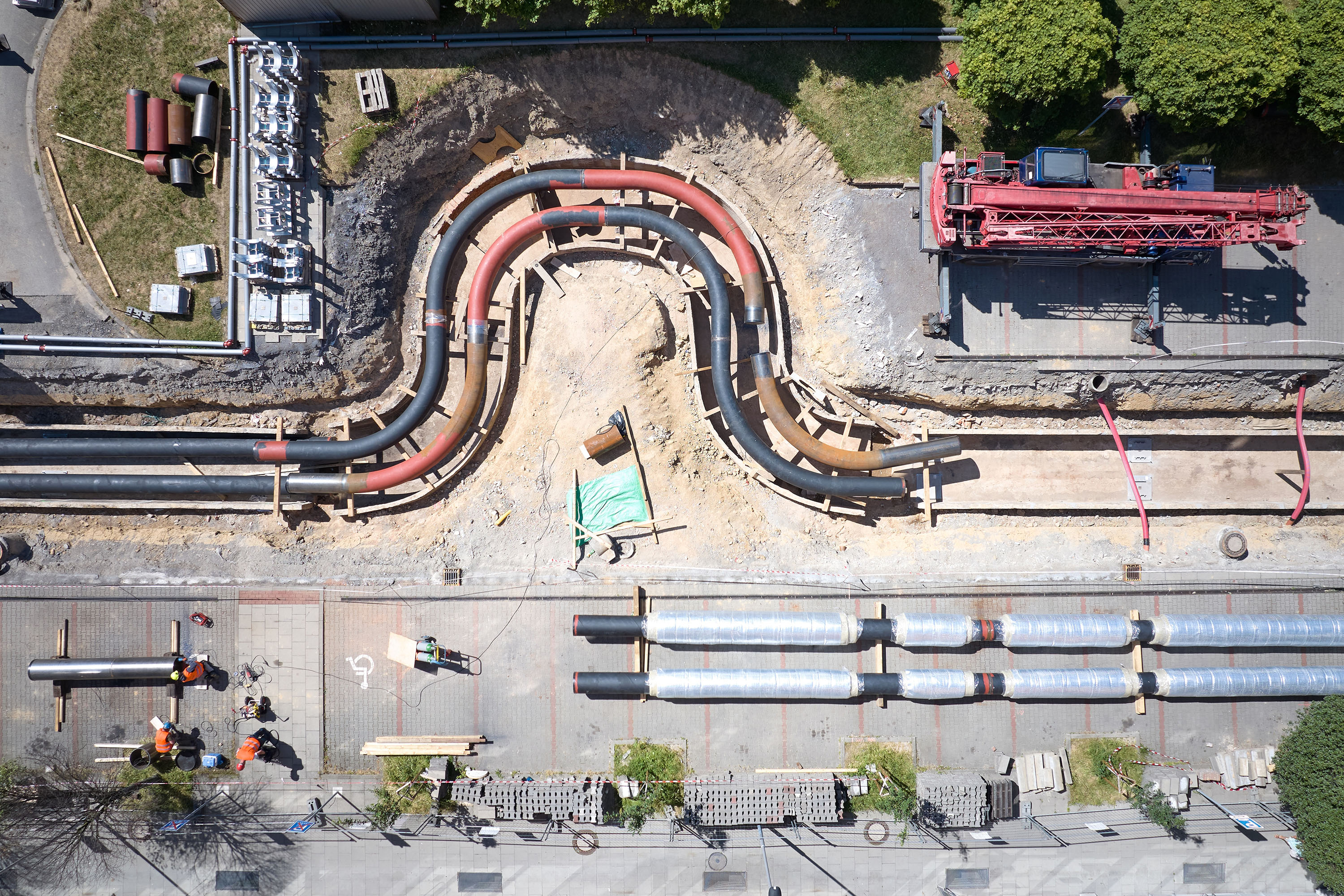
Although numerous studies demonstrate the value of district thermal networks to deliver energy efficiency, lower carbon emissions, and overall resilience, the majority are written for policymakers, utilities, or infrastructure planners. As a result, the commercial real estate market often lacks straightforward tools or frameworks to determine whether a district scale solution is feasible or advantageous for their own buildings or portfolios.
For commercial real estate to play a more active role in developing district thermal networks, building owners need to understand the value of district systems. But that requires knowing the approximate thermal demands of nearby properties and how all the buildings in the network will interact. This information is not typically available. Developers can rarely access neighboring buildings’ hourly load profiles, mechanical schedules, occupancy patterns, or retrofit plans.
In partnership with The Urban Land Institute (ULI), Carbon Signal set out to address these issues and help building owners gain perspective around the detail and nuance of district thermal networks. That way they can come to the table prepared, with a clear understanding of what district thermal networks could mean for their buildings.
The Solution
Early-stage district analysis, powered by Carbon Signal.
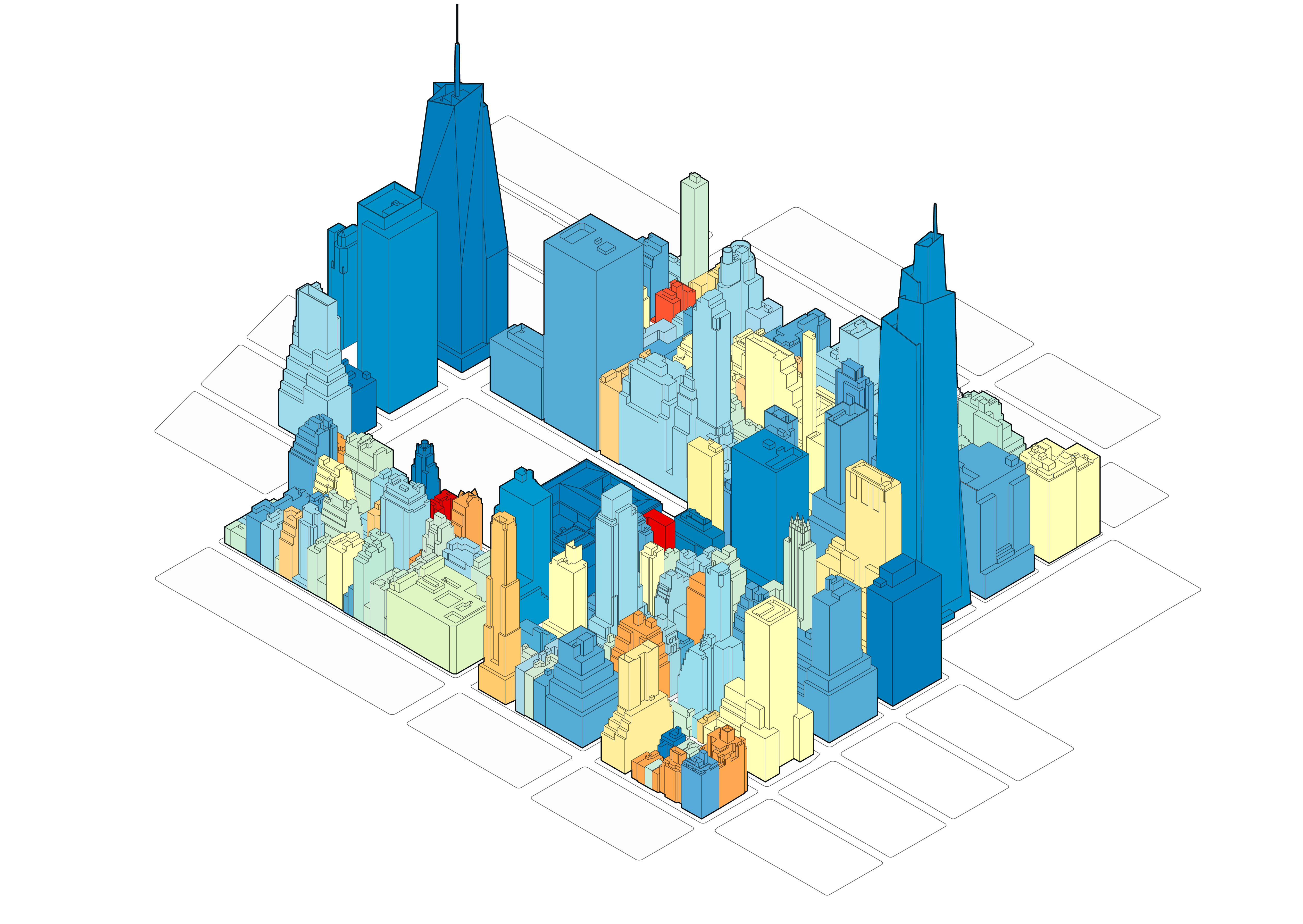
Many cities including Metro Vancouver, Seattle, Toronto, and New York have demonstrated that early-stage district-scale feasibility can be assessed using limited inputs, such as benchmarking datasets, in combination with other types of information, such as Geographic Information System (GIS)–based building geometry and local weather files. Benchmarking datasets are particularly useful; once energy use is reported consistently across an entire city, benchmarking data becomes the foundation for a citywide map of thermal activity. While previous studies were designed for utility-level planning, their methods can be easily adapted for the commercial real estate market and improved using physics-informed, data-driven modeling. With annual or (ideally) monthly utility data for each building, it’s possible to estimate total heating and cooling demand, assess heat-recovery potential, and determine the site-specific advantages of thermal networks versus individual building systems.
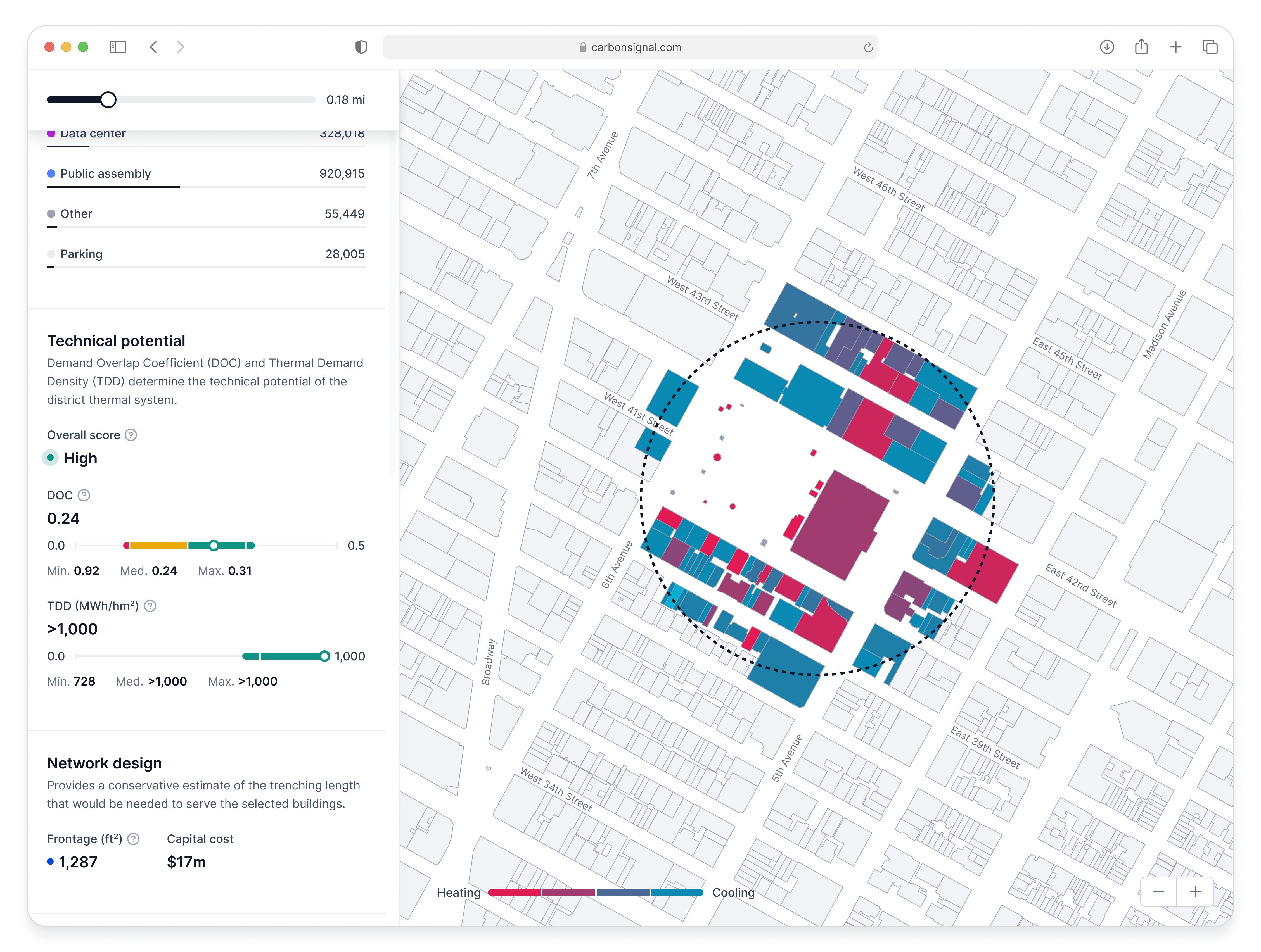
With ULI, Carbon Signal developed a district-scale analysis framework and simple tooling to help commercial real estate owners take part in early decisions about thermal networks. Built on Carbon Signal’s core analysis capabilities, it uses a small set of metrics that collectively help answer one question: does a district approach to electrification outperform standalone systems? The analysis tools leverage Carbon Signal’s API to apply the framework to any set of buildings in a district, highlighting which configuration of buildings benefit from district-scale electrification.
The Impact
Driving efficiency. Driving coordination.
To test the framework in a real commercial context, Carbon Signal applied it to three Manhattan districts – the Penn District, Chelsea-Meatpacking, and Bryant Park – chosen because they span a wide range of building types and ownership structures. At one end, the Penn District is made up mostly of office buildings controlled by a single developer. At the other, Bryant Park includes office, residential, and institutional buildings without a single anchor owner. Chelsea-Meatpacking falls in between, with several large mixed-use buildings owned by a single entity, surrounded by smaller commercial and residential buildings.
Carbon Signal used public benchmarking data to generate monthly heating and cooling load profiles for each building. A lightweight analysis tool built on the Carbon Signal API then combined those profiles into a district energy model, which was subsequently used to evaluate the potential for load sharing between buildings.
The results showed that district systems could deliver technical and economic value in all three areas, and they pointed to a distinct next step for owners in each. In the Penn District, high technical potential and a simple governance structure make it ready for more detailed analysis. In Chelsea-Meatpacking, the network would perform best if organized around a specific subset of buildings. In Bryant Park, the technical and economic case is strong, but fragmented ownership is the main obstacle, so the priority is bringing owners together to coordinate.
This proof-of-concept workflow was published in Block by Block: How Urban Real Estate Can Lead the Electrification Transition at the District Scale, with the goal of educating the commercial real estate market about the potential for early-stage assessment protocols. Further research and development may result in the public release of Carbon Signal’s tools for district analysis.
About ULI
The Urban Land Institute (ULI) is the oldest and largest network of cross-disciplinary real estate and land use experts in the world, with over 45,000 members covering every sector of real estate development and land use planning. Every year, the ULI Randall Lewis Center for Sustainability in Real Estate sponsors industry research on urban decarbonization through its E. Eugene John Fellowship. In 2026, Carbon Signal received the fellowship to develop a framework for early-stage district thermal network analysis, focusing on the needs of the commercial real estate sector.