
The Challenge
Changing portfolios and incomplete data.
Industrial and logistics portfolios are always changing. Every quarter, owners add, lease, re-lease, and dispose of sites. At the same time, owners have limited information about how each building performs, because in a typical industrial lease the tenant controls the utility accounts. As a result, owners who are considering capital upgrades have a limited window of opportunity to act and limited access to information to make good decisions.
The Solution
A calibrated model for every building.
Most modeling platforms need detailed building and energy data to get started. Carbon Signal works with whatever data is available, whether that’s a full utility history, a few months of partial bills, or a qualitative property condition assessment. It combines physics-based simulation with machine learning to turn that data into hourly energy models with a quantified range of uncertainty that reflects the quality of the underlying data: tighter when records are complete, wider when they’re sparse. These models give owners a strong foundation for analysis tasks, at the speed and scale demanded by industrial and logistics portfolios:
- Data quality control reconciles records from different billing systems into one auditable source. It flags gaps, outliers, duplicates, and meter-to-building mismatches before these issues propagate through a report.
- Compliance and stranding risk shows, building by building, which standards apply, when each asset will likely fall out of compliance or off a CRREM pathway, by how much, and what it takes to stay on pathway.
- Structured exports and pipelines send thermal and electric demand profiles, load duration curves, calibrated parameters, and intervention results into a client's own calculators, planning tools, and reporting templates. Exports follow a documented schema and regenerate when the models recalibrate.
The Impacts
A complete picture, with any amount of data.
Carbon Signal is working with two industrial portfolios, Amazon and Cabot Properties, that have limited energy data for many of their properties. For both, Carbon Signal reconciles energy records from different business units and billing systems into a single auditable source, filling the gaps along the way. It then quickly builds an energy model for each asset, so capital planning teams can see how every building performs. More data sharpens the model’s outputs, but it isn’t required to get started.
Compliance and stranding risk, building by building.
The same models show which standards apply to each asset, when it will likely fall out of compliance, and by how much. For Amazon, that means tracking exposure to building performance standards across jurisdictions as new ones take effect. For Cabot, it means identifying each building's likely CRREM stranding year and the interventions needed to stay on pathway.

Decisions at the moment when they matter most.
When a rooftop unit or boiler reaches the end of its life, the replacement decision can’t wait for a detailed site study and engineering assessment. Owners have a narrow window to decide whether to replace the equipment like-for-like or upgrade it. That choice matters most with electrification. Carbon Signal helps owners decide whether to electrify now or wait, comparing the full cost of an upgrade - including the costs of service upgrades - with the risk that new fossil-fuel equipment becomes a stranded asset.
Outputs that connect existing systems.
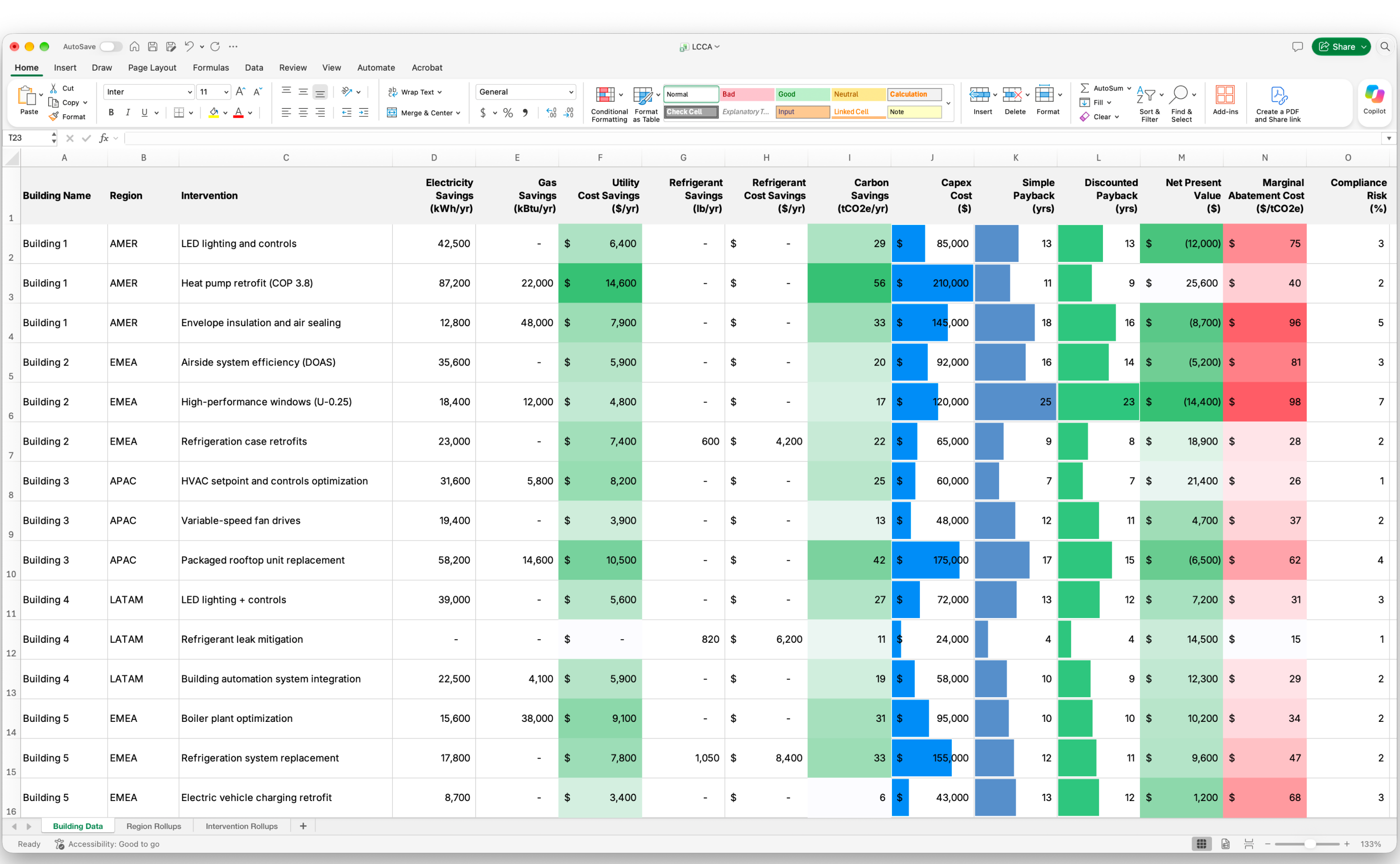
Amazon, Cabot, and other industrial portfolio owners already have their own internal tools for analysis and reporting. Carbon Signal’s outputs follow a consistent, well-structured schema, so owners can bring that data straight into the workflows they already use. Amazon, for example, tracks HVAC replacement dates in an internal tool. Carbon Signal’s thermal load profiles and system sizing data feed directly into it, so Amazon can see each replacement date alongside the specifications and options for new systems. Similarly, Cabot Properties uses Carbon Signal’s utility data reconciliation capabilities to power its ESG reporting. That way it can account for emissions across its entire portfolio, even though it has limited access to its buildings’ utility data.
About the Portfolios
Amazon Global Realty manages the real estate behind Amazon's operations network, including fulfillment centers, sort centers, and delivery stations worldwide. Its sustainability team uses Carbon Signal for data quality control, compliance and benchmarking, and the thermal and electric profiles behind equipment replacement and peak-demand planning.
Cabot Properties is a private real estate investment firm focused on industrial and logistics properties. Its ESG team uses Carbon Signal to model assets with limited tenant data, assess stranding risk, and support portfolio reporting.