

The Challenge
Big policy decisions, and data that rarely reaches the building.
Cities and states have set ambitious targets for decarbonizing their buildings, determining which incentives to fund, which neighborhoods to prioritize, where the grid will need reinforcing, and how fast the transition can move. But most of these decisions still rest on top-down forecasts built from simple heuristics. Those forecasts can predict how loads will shift in specific regions, but can’t say which buildings drive the changes.
The data that would answer those questions is incomplete. Benchmarking programs usually cover only large buildings, and they report monthly or annual totals, not the hourly demand that determines grid impact. Smaller buildings, which make up most of the stock in many neighborhoods, are often missing entirely. And the agencies doing the planning rarely have access to building-level utility data.
What's needed is an approach that starts from the buildings themselves, works with the data public agencies actually hold, and produces results that policymakers, utilities, and communities can look at and build on.
The Solution
Bottom-up building stock models, calibrated to existing city data.
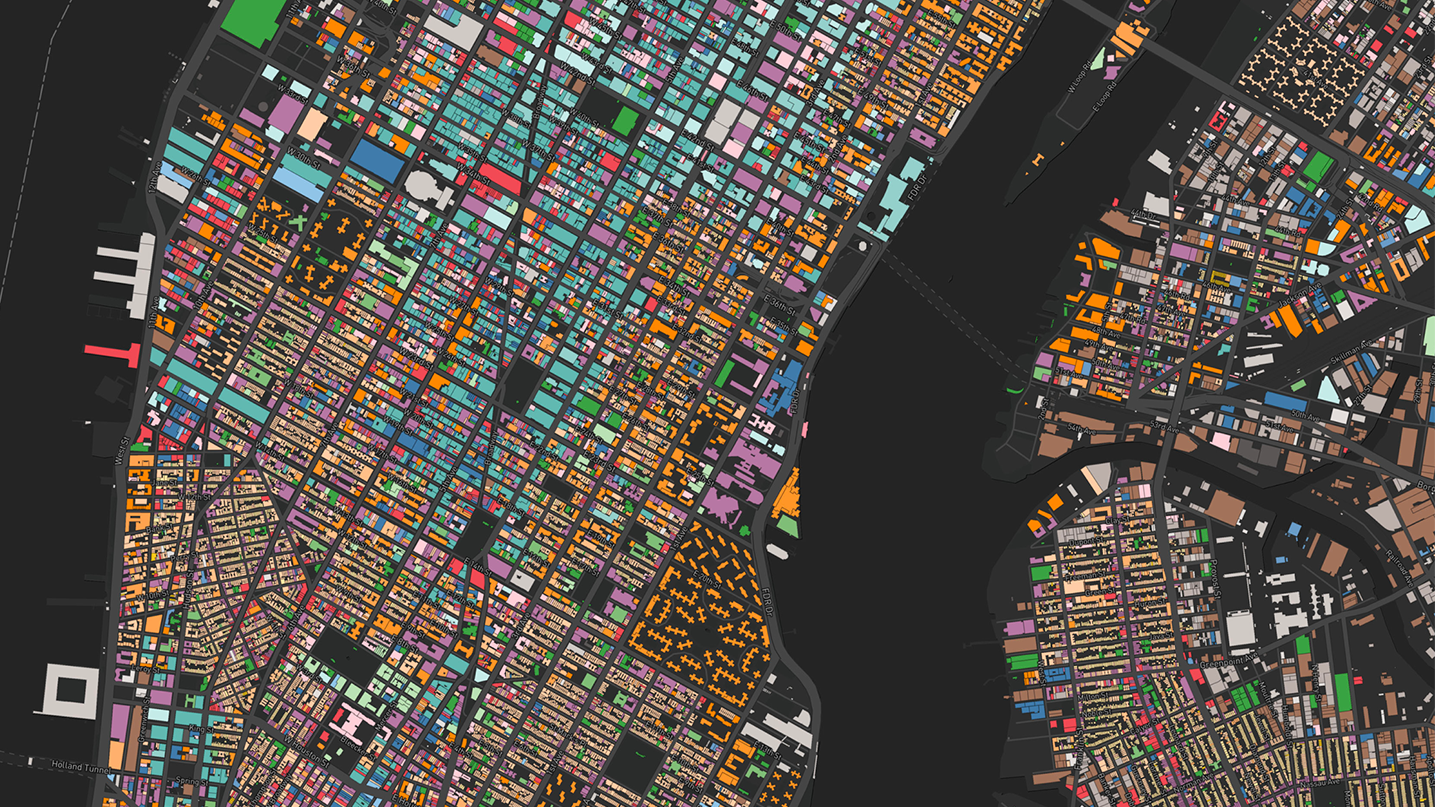
Carbon Signal builds energy models of entire building stocks from the bottom up. Rather than pre-define typologies that represent certain sectors of the building stock, we start with the data that actually exist - whether that’s benchmarking datasets, utility community energy data, or hourly load projections - to find the optimal set of models that capture statistically important nuances and variations in energy performance. With a conventional approach, a building stock model might utilize 20-30 typologies. With Carbon Signal, there might be thousands or hundreds of thousands of models used to represent the building stock at a much higher resolution.
Every model runs at hourly resolution, and results can be rolled up to whatever geography a decision calls for: a block, a census tract, a zip code, a utility network zone, a feeder, or a substation. The same models can then test policy and technology scenarios, including efficiency, electrification, demand response, onsite solar, and battery storage, and show how each one changes energy use, emissions, and peak demand across the stock.
The Impacts
Evidence for agencies, utilities, and communities to act.
For the Massachusetts Executive Office of Energy and Environmental Affairs, Carbon Signal's approach underpinned a bottom-up intelligence framework covering roughly 3 million buildings across the Commonwealth. It was developed together with EEA, MIT's Sustainable Design Lab, and the Applied Economics Clinic. The framework combines building-level energy simulation with commercial and residential adoption models, equity and environmental justice overlays, feeder- and substation-level grid impact analysis, and policy scenarios through 2050. It identifies the grid feeders that would go over 80% of their rated capacity under full electrification. Every assumption is transparent and editable.
Translating monthly demand profiles to hourly data.
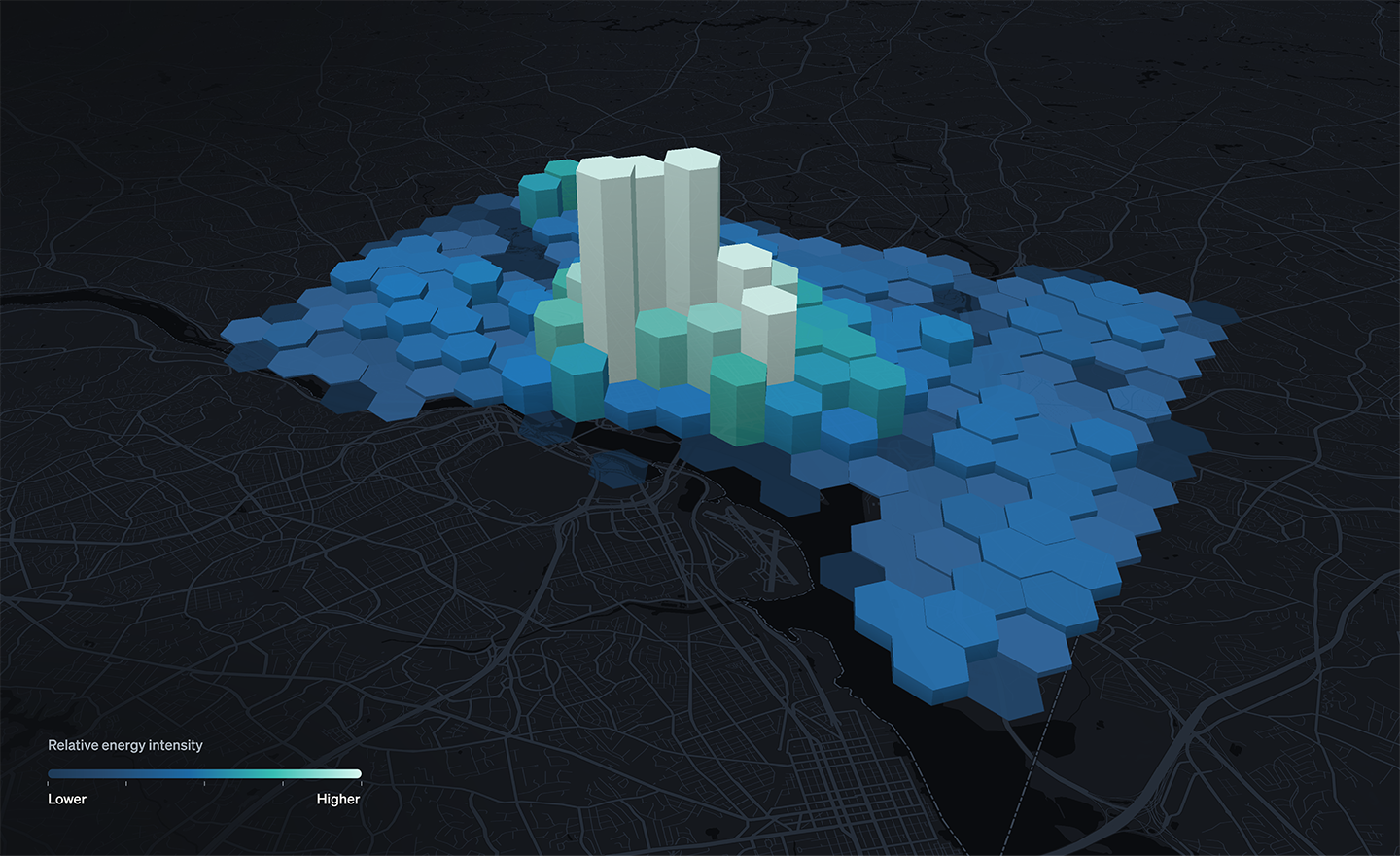
In Washington DC, a research project funded by the US Department of Energy and the DC Department of Energy and Environment set out to understand what widespread electrification would mean for grid reliability. The District's benchmarking data covered only buildings over 25,000 square feet, and only at a monthly resolution. Calibrated models produced hourly estimates of energy use across the District under several electrification scenarios. They showed that some areas would see no increase in peak demand at all, while others could absorb the increase through efficiency improvements in line with the latest city energy codes. The hourly profiles also supported further analysis of vehicle electrification and distributed battery storage.
Neighborhood-scale options for environmental justice.
In Sunset Park, Brooklyn, two peaker plants that run during periods of peak demand are a major source of local air pollution in an under-resourced community. Working with a coalition of community partners, Carbon Signal built an hourly model of the neighborhood, calibrated against NYSERDA's community energy use data and Con Edison's hourly load projections, to test whether distributed energy resources could replace them. Efficiency, demand response, solar on 8% of rooftop area, and 30 MW of battery storage together cut peak demand by 38%, demonstrating a pathway to eliminating a major source of pollution in the neighborhood.
A citywide answer to whether the grid is ready.
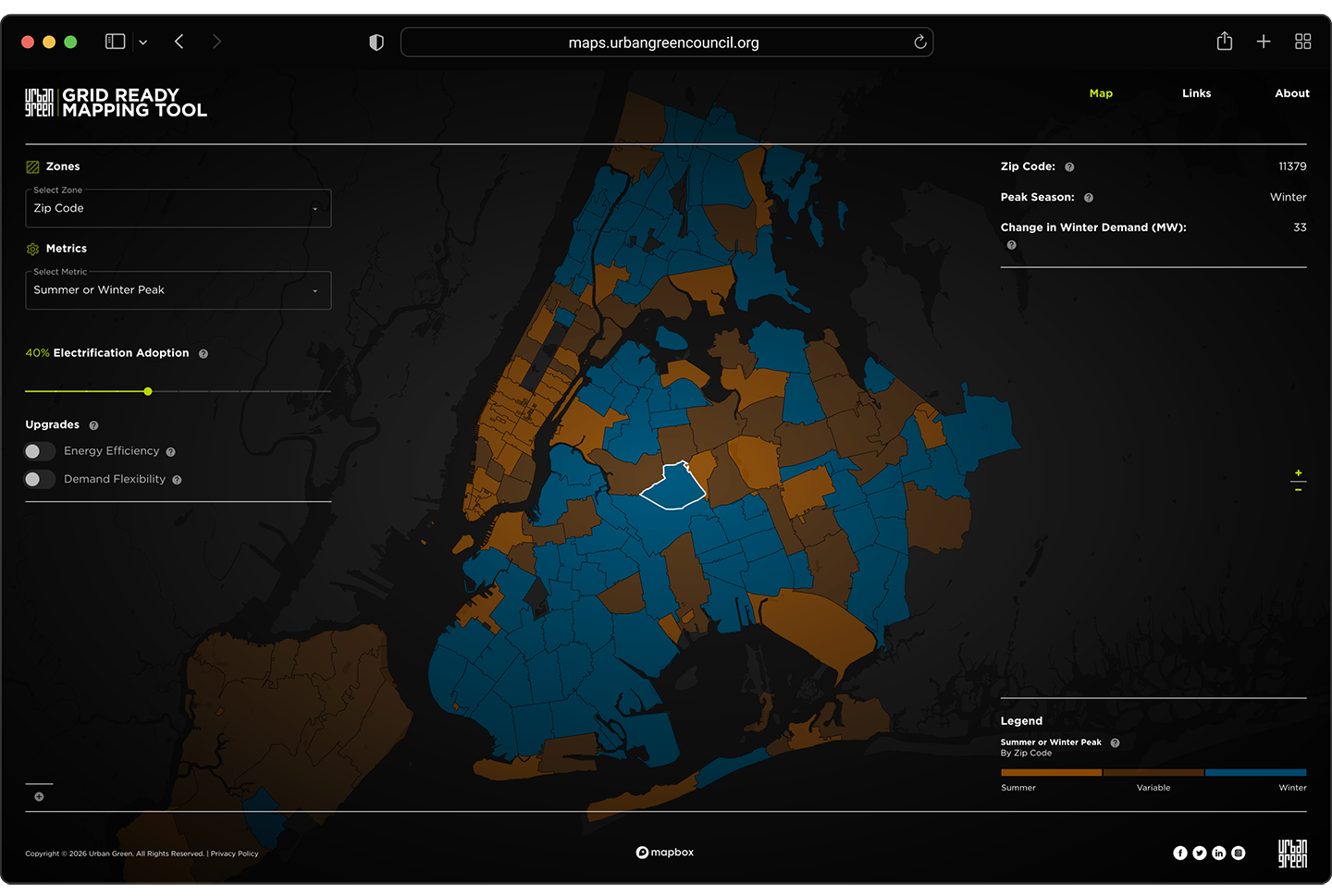
Working with Urban Green Council, Con Edison, and NYSERDA, Carbon Signal modeled New York City's existing building stock, which included more than 1 million buildings. We identified roughly 30 important typologies, calibrated each typology's models to measured monthly energy use, and then added the results up by floor area for each grid network zone. Four electrification scenarios were tested, from heat pumps alone to heat pumps combined with low-cost efficiency and demand flexibility. We found that citywide electrification would eventually raise peak demand by about 40%, with grid upgrades needed first in the outer boroughs, where low-rise residential buildings dominate. Because the grid has spare winter capacity, building electrification poses no immediate risk to it. The results were published as a public, interactive map for policymakers and residents.
About the Institutions
The Massachusetts Executive Office of Energy and Environmental Affairs (EEA) oversees the Commonwealth's energy and environmental agencies and leads its planning for building decarbonization under the state's climate targets. The DC Department of Energy and Environment (DOEE) is the District's lead agency for energy and environmental policy, including its building energy benchmarking program and its path to carbon neutrality by 2050. Urban Green Council is a New York City nonprofit that researches and advances policy for sustainable, decarbonized buildings.