

The Challenge
Ambitious commitments, mixed portfolios, and little building-level evidence.
Large companies have made public commitments to carbon neutrality, carbon-negative operations, or 24/7 carbon-free energy, often with deadlines only a few years away. Meanwhile, cities are introducing building performance standards that put a price on every ton of carbon above a limit. Real estate and sustainability teams, who manage hundreds of buildings across many countries, climates, and grids, have to turn those commitments into action and avoid penalties from emerging regulations.
These portfolios are rarely uniform. Offices sit alongside data centers, labs, and commercial kitchens. Companies own some buildings and leases others, which changes how much control they have over upgrades. Utility data is often incomplete, and documentation of building systems is scattered. Facilities managers, sustainability strategists, and executives each work toward different goals from different information.
As a result, plans tend to be built either from detailed audits of a few buildings, which take too long to cover the whole portfolio, or from portfolio-wide rules of thumb, which can't say which building to act on first, what it will cost, or how much it will move the target.
The Solution
Calibrated models for every building, linked to targets and capital plans.
Carbon Signal builds a calibrated energy model for every building in the portfolio, combining physics-based simulation with machine learning. It starts from location, size, building type, and whatever utility data exists, and produces a complete model with a stated level of confidence. The confidence range narrows as more information arrives, from interval data to on-site observations.
The same models connect each building to the decisions around it. They separate Scope 1 emissions from on-site fuel use from Scope 2 emissions from electricity. They test efficiency, electrification, onsite solar, and storage, both for each building and across the whole portfolio. They project compliance with local performance standards year by year, and they show how each measure changes annual energy use and emissions. The results become roadmaps that show which buildings to act on, in what order, at what cost, and with how much certainty.
The Impacts
A shared basis for decisions across the organization.
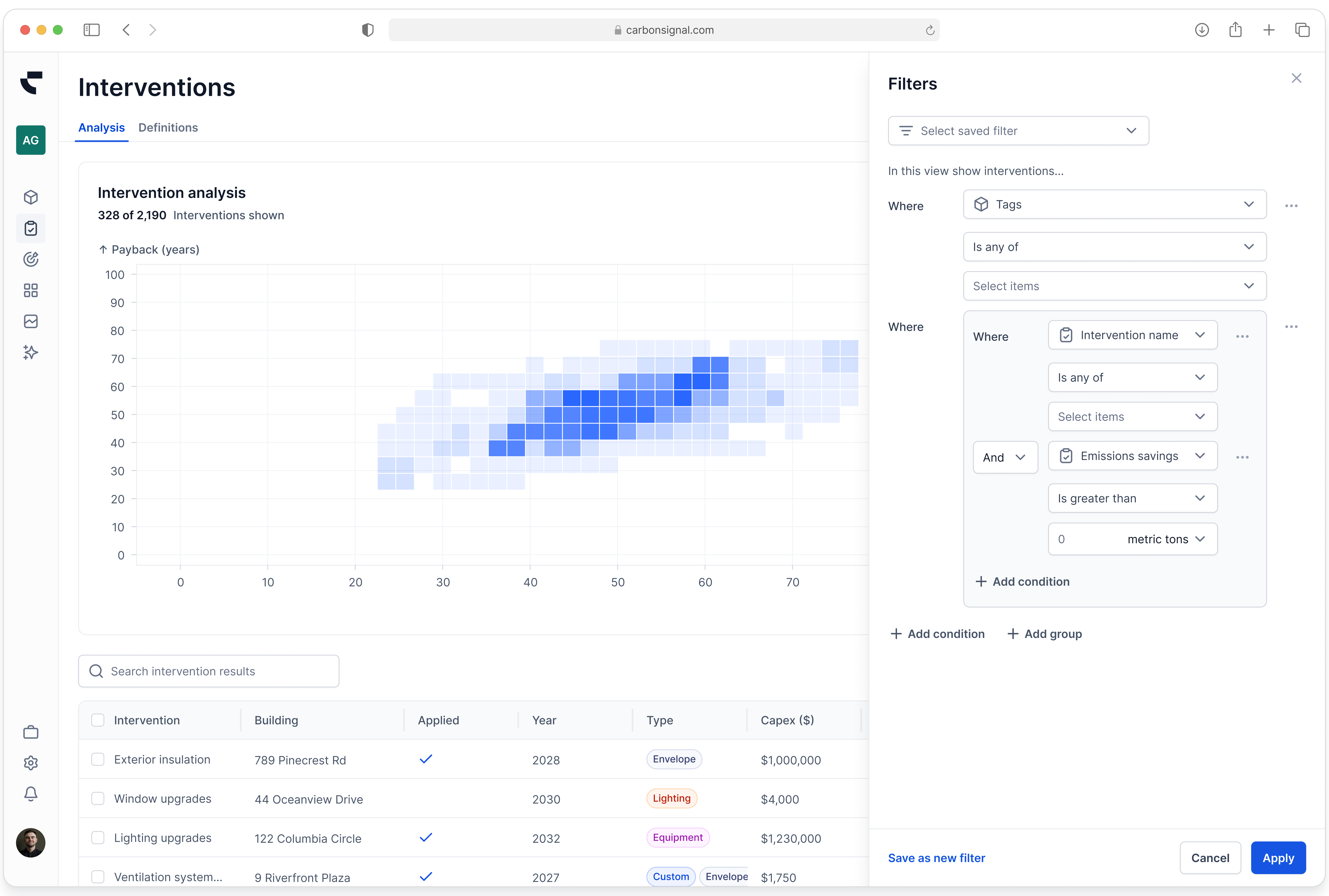
With Carbon Signal, teams no longer need a detailed audit before they can underwrite a decarbonization plan: they can see where they have the confidence to act, where they don't, and what information would close the gap. Facilities, sustainability, and leadership work from the same assumptions, so trade-offs between goals are explicit. The models support retrofit roadmaps, benchmarking, and lease diligence.
Commitments backed by costed, building-level plans.
One corporate customer, committed to becoming carbon negative by 2030, used Carbon Signal to analyze 550 buildings from monthly utility data alone. The calibrated models estimated the impact of electrifying kitchens, space heating, cooling, and hot water in each building, and those results were sequenced into a year-by-year pathway through 2030. With costs estimated for each intervention, the analysis pinpointed $40–60 million in priority capital investments that would avoid more than 4,000 tons of emissions each year. That pathway now anchors the client’s broader decarbonization strategy.
Comprehensive compliance assessments.
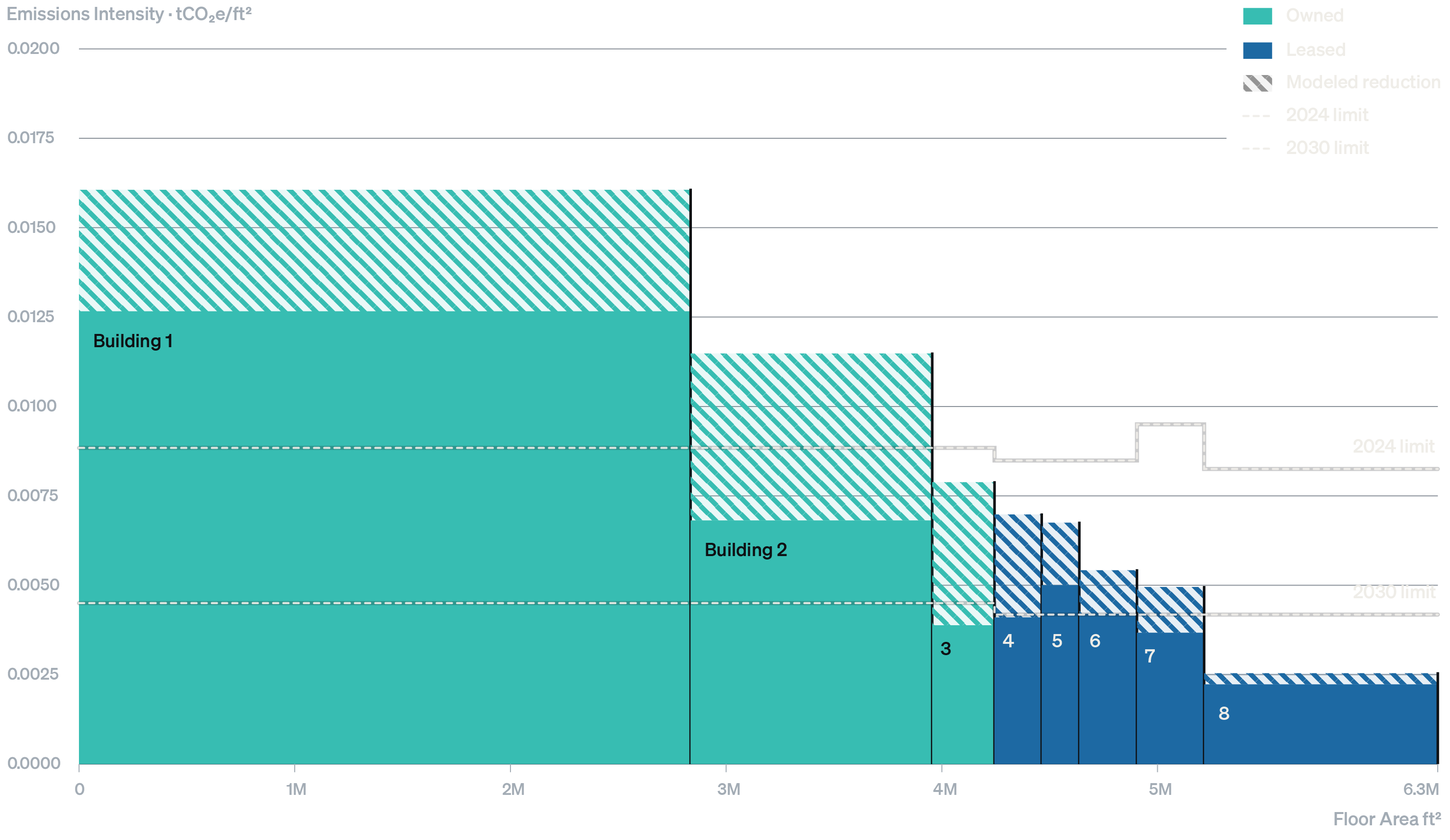
For another corporate customer in New York City, with over 6 million square feet of mixed use space in Manhattan, Carbon Signal modeled each building's emissions against the limits set by Local Law 97 and rapidly assessed interventions to meet those limits. This analysis provided the foundation for a comprehensive effort by the team to design a bespoke Local Law 97 compliance roadmap for the customer, which included detailed design specifications and sequencing for interventions, and explorations of alternative compliance strategies, such as investments in community solar programs.
Planning for carbon-free energy. Carbon Signal can also handle more demanding analyses. A technology company committed to running on carbon-free energy every hour of every day by 2030 used Carbon Signal to model 140 buildings in the San Francisco Bay Area, about 90% of which still heated with natural gas. The hourly energy profiles revealed something counterintuitive: efficiency measures cut energy use and emissions but barely moved the share of carbon-free energy, because they neither eliminated gas nor shifted electricity use to cleaner hours. Electrifying heating and adding enough solar and battery storage, by contrast, would raise most buildings’ carbon-free energy share from 30–40% to 80–85%. The analysis also showed how far the company still had to go to reach 100%.
About the Portfolios
The information above came from work for several confidential technology clients, as well as Amazon. Amazon's Global Real Estate and Facilities (GREF) team manages Amazon's corporate offices and other workplaces worldwide, including real estate transactions, facility operations, and sustainability initiatives. GREF uses Carbon Signal for retrofit roadmaps, benchmarking, and lease diligence across its office portfolio.